
Hunt To Conserve?
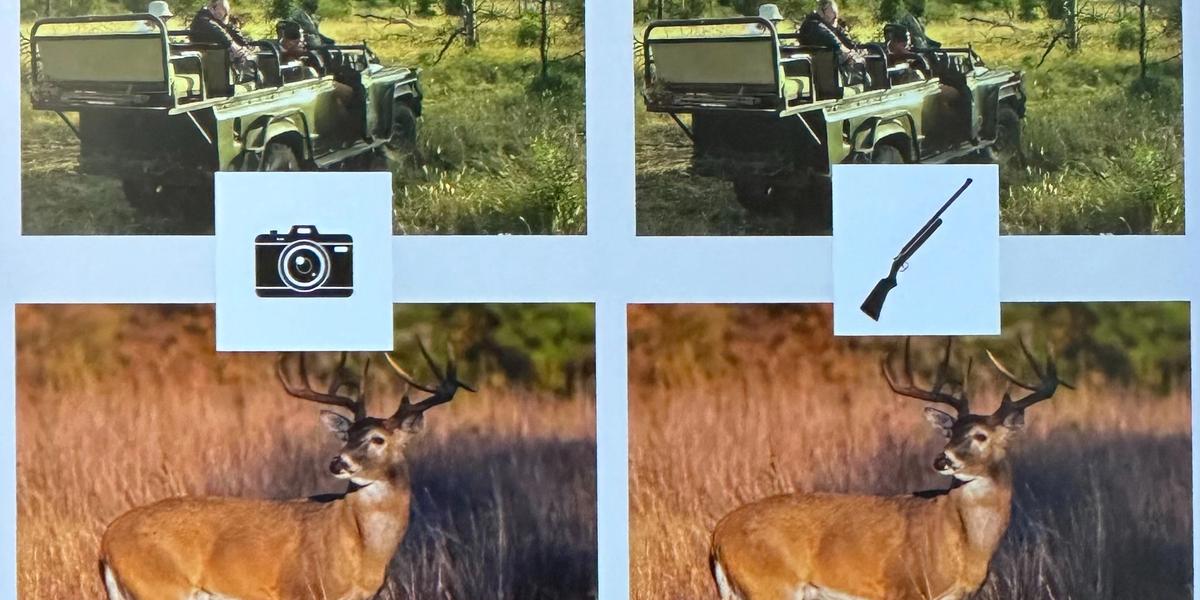
I recently spoke with a friend who had travelled to Tanzania and was surprised to learn that wildlife can be hunted under the banner of conservation. Coming from Kenya, the notion that animals could be hunted to protect them, particularly through sport, felt contradictory. In trying to explain this, I found myself outlining two key arguments often raised in the debate: the economic case, where hunting fees are said to fund conservation and anti-poaching efforts, and the historical roots of the practice, particularly its links to colonial hunting traditions in Africa.
In this blog, I focus primarily on the historical foundations of trophy hunting, while briefly touching on the economic arguments that continue to shape its defence today. Although I personally oppose the practice, this article is intended as a starting point for you, the reader, to better understand the broader context of the debate, as well as some of my own reflections on the issue. In the coming months, I hope to explore the topic more deeply from both a personal and policy perspective.
History Of Trophy Hunting
During the late nineteenth and early twentieth centuries, European settlers and wealthy travellers pursued large wildlife as a leisure activity, preserving animals as trophies that symbolised adventure, prestige, and imperial dominance. Colonial administrations often restricted indigenous communities' access to wildlife while granting privileges to officials and foreign hunters. In Southern Africa, these patterns became embedded in law: for example, in 1975, Zimbabwe shifted legal rights for wildlife management from the state to private landowners, particularly white ranchers. Hunting became commercialised, tied to elite privilege, and presented as both a sport and a form of wildlife management.
In 1996, Safari Club International (SCI), a US-led hunting organization, published a “Strategic Plan for Africa” that explicitly aimed to secure Africa as a premier destination for trophy hunting. SCI promoted private sector-led hunting as a tool for conservation, economic development, and rural growth, but with a strong emphasis on profit and global market access.
This historical and organizational context is particularly visible in Namibia. Following its colonial and apartheid-era land dispossession, communal lands where Indigenous peoples retained some control became the focus of Community-Based Natural Resource Management (CBNRM) programs. These conservancies, while presented as vehicles for local development and wildlife stewardship, are linked to private hunting operators and commercial tourism.
But not all countries continued the trophy hunting model. Kenya, a former British colony, took a markedly different path, prioritizing protective stewardship over commercial exploitation. In July 1989, President Daniel Arap Moi ordered the burning of 12 tonnes of confiscated ivory in Nairobi National Park, a stockpile valued at around USD 3 million at the time, roughly USD 8 million today. Although the ivory came from illegal wildlife trafficking, Kenya’s decision to destroy rather than sell it sent a powerful symbolic and political message: wildlife is not a commodity. This act framed conservation as a moral and cultural commitment rather than a financial calculation, reflecting the values and traditions that many Kenyan communities attach to wildlife.
The present
Today, trophy hunting contributes substantial economic value to several African countries. Research from North-West University estimates that hunting tourism generates approximately USD 2.5 billion annually and sustains around 95,000 jobs in South Africa. Advocates contend that, beyond its economic impact, trophy hunting functions as a wildlife management mechanism, helping to regulate species populations and maintain ecological balance within biodiversity-rich landscapes.
However, this justification remains contentious. Effective ecosystem management does not require lethal intervention; wildlife balance can be maintained through measures such as establishing migratory corridors and supporting natural predator-prey dynamics. Resources currently directed toward hunting could instead be invested in ecological research and the development of sustainable habitats, achieving both conservation and economic objectives without compromising animal life.
A good example of what is possible is Kenya’s conservation model, which relies primarily on wildlife tourism rather than hunting. Kenya’s tourism sector is a major economic driver, with earnings reaching approximately KSh 452 billion (roughly USD 3.5 billion) in 2024. The sector continues to grow, with projections for annual earnings of USD 3.9–7.8 billion by 2027–2028. A clear indication that conservation outcomes can be achieved without incorporating trophy hunting into wildlife management.
Kenya’s conservation system is definitely not perfect. It continues to grapple with challenges, including inefficiencies in benefit-sharing, limited resources, and ongoing human-wildlife conflicts. Yet it has succeeded in establishing a model where local voices are considered, cultural and ecological values guide decision-making, and economic gain is not the sole measure of conservation success.
The future
What does the future of conservation look like in light of trophy hunting’s complex legacy? It is a difficult question to answer. While hunting has generated income and supported some communities, its roots in colonial exploitation and the commodification of wildlife cannot be ignored. Equally significant are the values and ethical questions surrounding the practice, which continue to influence how conservation is debated and imagined today.
The defence of monetized conservation rests on a utilitarian argument: if the death of one animal secures habitat protection for many others, the outcome justifies the means. Yet this reasoning is increasingly difficult to sustain. It assumes that financial gain necessarily translates into ecological sustainability and equitable distribution of benefits. It also overlooks deeper, long-term moral consequences. When destruction becomes institutionalized as a funding mechanism, conservation begins to depend structurally on the very harm it claims to mitigate. The result is a troubling feedback loop in which the survival of wildlife becomes tethered to its selective elimination.
Justice in conservation demands coherence between means and ends. A model that protects life by commodifying and destroying it risks eroding both ecological integrity and moral legitimacy. Ultimately, a conservation model that relies on destruction for its survival is not a success; it is a failure of basic justice.
By; Memo Some
- North-West University. (2022). The Economic Impact of Trophy Hunting in South Africa: Post-COVID Assessment. Potchefstroom, South Africa.
- World Travel & Tourism Council (WTTC). (2025). Economic Impact Report: Kenya 2025. https://wttc.org/Research/Economic-Impact
- Macdonald, D., & Burnham, D. (2016). Cecil the Lion: Science, Ethics and Policy in Conservation. Oxford University.
- https://www.ebsco.com/research-starters/political-science/kenyan-president-burns-fortune-ivory
- https://wttc.org/Research/Economic-Impact
- https://safariclub.org/protect-hunting/key-issues/science-based-wildlife-management/

About the author
Memo Some is completing a Master of Public Policy at the Blavatnik School of Government, University of Oxford. Her work spans wildlife conservation in Kenya, climate policy and institutional reform, though these days she can often be found writing over a cup of coffee at GAIL’s.
Disclosure: Memo was not paid by GAIL’s for this piece, and nobody at GAIL’s asked her to write it. She is simply a loyal customer who loves her local bakery and appreciates the warmth she receives in return.